
If you walked into a typical office lobby in January of 2025, the tension was palpable. The elevators were packed, but the vibe was… complicated. We were staring down the barrel of strict Return-to-Office (RTO) mandates, managers were wielding attendance spreadsheets like shields, and employees were frantically trying to figure out if their commute was actually worth the price of admission.
Fast forward to this December, and things feel different. The dust has settled. We aren’t talking about "the return" anymore; we are just talking about work.
2025 wasn’t the year the office died, nor was it the year everyone magically marched back to their cubicles five days a week. Instead, it was the year companies tried to force RTO, but their employees showed them that the old world is gone. Now, the mandates are fading, and we are all just trying to make sense of how the workplace changed this year.
The Return-to-Office Reality Check
Let's get the elephant out of the room: yes, Return to Office mandates dominated the headlines. Amazon brought 350,000 employees back full-time. JPMorgan Chase ended remote work entirely. The federal government ordered everyone back. Instagram went five days a week while Meta kept its three-day hybrid schedule.
You would think that if the big tech companies summoned everyone back into the office there would be a snowball effect and more companies would follow suit.
Despite the noise, only 27% of companies returned to fully in-person models by the end of 2025, and 67% of companies continued offering some level of flexibility. The most common setup was 3 days per week in the office, with over 50% of companies letting employees choose which days they come in.
The weekly average office utilization of the top 10 U.S. markets hit a new post-pandemic high in January 2025 at 54.2%, and the US national average occupancy rate reached 55.13% in the last week of February 2025. Not bad, but still well below the old five-day-a-week packed offices.
Coffee Badging: The Quiet Rebellion
If you didn't hear about 'coffee badging' in 2025, you were probably happily working remotely. This was the year employees showed up to the office just long enough to swipe their badge, grab a coffee, say hi to a few people, and head back home to actually get work done.
The numbers were wild. 44% of hybrid workers acknowledged coffee badging, and 75% of companies reported struggling with employees coffee badging. Even more surprising? 47% of managers admitted to coffee badging themselves.
Some companies tried to crack down. Samsung rolled out an "RTO monitoring tool" specifically to combat the trend. Amazon managers started having one-on-one conversations with employees about their "meaningful amounts of time" in the office.
The real issue with coffee badging isn't that employees are "gaming" the system; it's that the system has become a game of empty compliance. When 44% of hybrid workers show up just long enough to swipe a badge and grab a latte, it creates a "ghost town" effect where the office is technically full on paper but culturally empty in practice.
This behavior is a massive red flag that your office days are poorly designed, your employees are paying the "commute tax" to tick a mandatory box rather than to collaborate or connect.
Companies that encourage their employees to come into the office must ensure that office activities are actually worth the commute; otherwise, they risk wasting both the facility's potential and the employee's time.
Solving the Commute: The Rise of Regional Hubs
The smartest response to the resistance wasn't stricter rules. It was better locations. 2025 saw the death of the single massive headquarters and the rise of the regional hub.
Rather than maintaining one large central office, companies in both the US and UK opened smaller locations closer to where employees actually lived. Half of UK firms established coworking or satellite offices in suburban or regional locations. In the US, decentralized office spaces including satellite offices and regional workspaces replaced the single-headquarters model.
These weren't full-scale offices. They were collaboration hubs for teams to meet, work together for specific projects, then disperse. They typically offered hot-desking areas, meeting rooms, quiet zones, and social spaces, all tech-enabled for remote collaboration.
Satellite hubs reduced commute time dramatically. Instead of daily 62-minute round trips (the US average), employees traveled 10-15 minutes to local hubs. This preserved some benefits of office work while eliminating the commute penalty. UK research found workers increasingly sought spaces within a 10-minute walk of transport hubs.
Decentralization acknowledges that work happens in networks, not hierarchies, and those networks don't need to be co-located constantly. The traditional hub-and-spoke model (headquarters as hub, everything else as periphery) gave way to distributed networks where any location could serve as a collaboration point. This fundamentally challenged assumptions about office culture requiring everyone in one building.
How People Actually Worked
Beyond the headlines and the hub locations, 2025 gave us hard data on daily work habits. The workforce is no longer a uniform block.
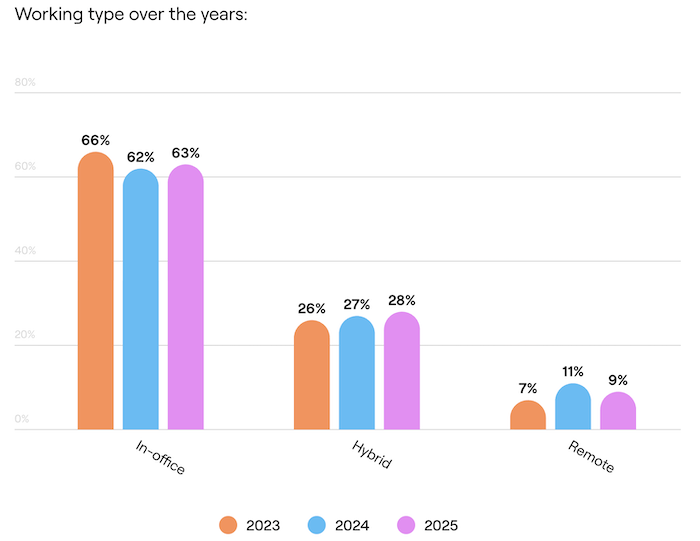
63% of full-time employees were completely on-site, while 9% were fully remote, and 28% worked a hybrid arrangement. But those numbers only tell part of the story.
Hybrid workers were strategic about their office days. They came in for collaboration, team meetings, brainstorming sessions, and relationship-building. They stayed home for deep focus work, individual tasks, and anything requiring uninterrupted concentration. The best organizations designed office days around these patterns instead of fighting them.
Millennials and Gen Z had the most flexible schedules, with about a third of each generation working in a hybrid arrangement. Meanwhile, older workers were more likely to be fully on-site, either by choice or by the nature of their roles.
Finance and consulting firms pushed hardest for in-office presence. Tech companies, despite the headlines, largely stuck with hybrid models.
What we want to see in 2026
IN:
- Designed office days around purposeful collaboration, not performative presence
- Listened to employee feedback and adjusted policies accordingly
- Made the office a destination, not a default
OUT:
- Enforced rigid RTO mandates without explaining the why
- Tracked badge swipes instead of measuring outcomes
- Ignored coffee badging until it became a culture problem
- Assumed employees would just "get over" their desire for flexibility
Looking Ahead
If 2025 taught us anything, it's that superficial fixes don't work. Mandating office days without making them valuable, tracking employee activity without addressing actual engagement, none of these solve the real workplace problems.
The organizations that thrived in 2025 were the ones that stopped pretending they could control every aspect of how work happens. They stopped measuring presence and started measuring outcomes. They stopped surveilling activity and started trusting competence.
With 2026 now in front of us, we can’t wait to see how the workplace evolves this year.
Key Takeaways
- Mandates vs. Reality: While Amazon and JPMorgan made headlines with strict RTO policies, they were the exception. 67% of companies stuck with flexibility, proving hybrid is here to stay.
- The "Commute Tax" is the Enemy: The rise of regional hubs signals a shift away from massive HQs. Companies are slashing the average 62-minute commute to just 15 minutes by meeting employees where they live.
- Coffee Badging is a Symptom, Not a Disease: When 44% of hybrid workers swipe in just to tick a box, it’s a sign that your office design is failing to provide real value.