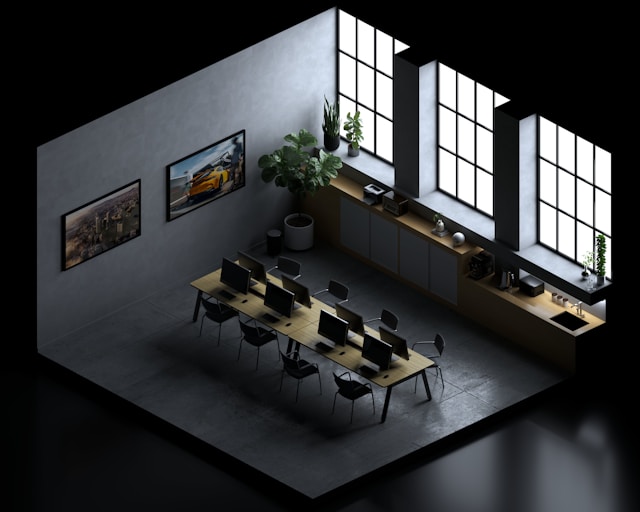
Over the past few decades, every shift in office design has reflected the pressures and priorities of its time. Cubicles, which became widespread in the 1980s and 1990s, were intended to provide focus but often turned into impersonal grids that prioritised efficiency over satisfaction. Open-plan layouts followed in the 2000s, mirroring the push for transparency and collaboration, even if they often created more distractions than teamwork. Activity-based working grew as knowledge workers demanded flexibility, offering a menu of spaces to match different tasks. And most recently, hybrid work has risen after 2020 not as a fad but as a practical solution to a workforce that values autonomy, mobility, and choice.
Each stage of this evolution has reshaped the culture of work. From cubicles to activity-based working, and now to hybrid setups powered by technology, the office has been in constant flux.
With so many rapid shifts, we can’t help but wonder: what’s the next big thing? If the last few decades have taught us anything, it’s that the office is a living experiment. Each wave of change reveals what employees value most: focus, flexibility, and seamless collaboration. As we look ahead to 2030, the question isn’t whether the office will change again, but how.
In the sections that follow, we’ll explore what the next era might look like: the evolution of office layouts, the rise of well-being and sustainability, the role of smart technology, and why these elements will define the future of work.
How will The Workplace Experience look like in 2030?
Hybrid & Flexible Layouts
The office is no longer a one-size-fits-all environment. Instead of rows of identical desks, companies are carving offices into choice-based zones. Need deep focus? Retreat to a silent library-style zone or acoustic pod. Need collaboration? Head to the café area or huddle space.
The numbers confirm the trend. Collaborative “we” spaces now take up 20% of office floor plans (up from 14% in 2021), while personal “me” spaces like assigned desks have shrunk. And the open office, once hailed as the future, is losing ground: workers in open-plan setups report 86 minutes of lost productivity per day and higher stress levels.
It is safe to say that employees thrive when they can choose how and where to work. Hybrid offices resolve the open-office vs. private-office debate not by picking one side, but by offering both.
Vertical Offices & Destination Villages
In dense cities, high-rises are evolving into vertical campuses. Instead of just stacked floors of desks, they feature sky gardens, rooftop running tracks, atriums, and lounges that create community within towers. Google’s London HQ, for example, includes a 300-meter rooftop garden with over 250 trees.
Beyond verticality, the “destination office” is emerging. Companies are designing workspaces as villages: places with wellness centres, stylish cafés, gyms, event spaces, and even childcare. The goal is to make the office a destination worth visiting, blending work with lifestyle. We already see this happening; employees need a reason to be in the office and to justify the commute.
This shift also leans on resimercial design, blending residential comfort with commercial function. Offices now include cosy couches, warm lighting, and hotel-like lobbies. Employees compare the office not to competitors, but to the comfort of home. If the workplace feels sterile, it loses.
Intergenerational & Inclusive Design
For the first time, five generations are working side by side. Gen Z expects mobility, Millennials want collaboration, Gen X values balance, Boomers often prefer structure, and workplaces need to cater to all.
Inclusive design means ergonomic chairs and sit-stand desks for comfort, plus informal zones for younger staff. It means quiet rooms, prayer and lactation spaces, and accessible navigation for employees of all abilities. With 15–20% of the workforce being neurodivergent, focus pods and sensory-friendly zones are becoming standard.
Inclusivity isn’t just physical. Policies and culture matter too: flexible hours for caregivers, anchor collaboration days for hybrid consistency, and technology that works for everyone.
People-Centric Office Spaces
Smart, Health-Driven Furniture & Materials
Smart desks and chairs auto-adjust to posture, remind users to move, and track usage patterns to encourage healthier routines. Lighting systems mimic natural daylight to support circadian rhythms, while antimicrobial surfaces and improved air filtration reduce health risks.
Offices are being reimagined not just as places to work, but as spaces that reinforce community and connection. Preventive healthcare can become a staple in the workplace: wearables and health apps can track stress, hydration, or heart rate, nudging employees toward healthier habits.
Biophilic Design, Climate, and Sustainability
Offices rich in greenery and daylight report 15% higher well-being and 20% fewer sick days. Plants, greenhouse-style spaces, and water features will be central to 2030 workplaces.
Yet sustainability now goes hand-in-hand with climate resilience. Rising global temperatures and extreme weather events will push companies to invest in green infrastructure, cooling strategies, and resilient buildings. Carbon tracking and circular design will be embedded in how offices operate, with governments moving from incentives to mandates. The workplace of 2030 will have to function as part of broader climate adaptation strategies.
Takeaway for workplace experience teams: Employees expect workplaces that safeguard both their personal health and the planet. Offices that respond to climate pressures while offering wellness-first environments will stand out as magnets for talent.
Technology & Smart Workspaces
When we think about the office of 2030, maybe the real question isn’t what new tools will appear, but how the way we work will end up defining both the walls around us and the technology inside them. In this section, we have more questions than answers because the future of the office has many variables.
Let’s look at a little bit of the demographic variable. Many economies will soon have more retirees than active workers. With fewer people commuting in, do offices shrink, becoming smaller, smarter spaces with modular layouts and more shared zones? Or does the opposite happen? If leaner teams have to cover more ground, will we end up spending more time in the office, maybe even six days a week, simply because there are fewer of us to do the work?
Then there’s AI. According to the World Economic Forum, 86% of employers expect AI and information-processing technologies to transform their businesses by 2030. Does that mean the classic five-day office week dissolves into four, because automation handles routine tasks and human effort is focused on higher-value, collaborative work? Or does AI amplify the need for training, peer-to-peer learning, and knowledge sharing, making the office even more of a hub than it is today?
There was this interesting article that argued that as AI takes over more technical tasks, companies will shift their recruitment focus away from hard skills and toward soft skills like adaptability. According to the World Economic Forum, 44% of today’s tech skills will be irrelevant by 2027, and IBM research shows that most technical skills lose half their value in just two years.
If adaptability becomes the new hiring priority, offices will need to support constant learning and reinvention. Instead of floor plans dominated by rows of desks, we may see layouts that emphasise training rooms, peer-to-peer learning hubs, and flexible project spaces where employees can continuously reskill. Cultural and social areas could play a bigger role too, helping teams build the trust and collaboration that adaptability demands.
Technology will play its part in redefining the layout. AR, VR, and telepresence robots could become part of everyday coordination with global teams. Can you imagine having your stand-up meeting via VR? This raises another question: will we need fewer meeting rooms if much of this happens in the metaverse? Or will we need different kinds of meeting rooms as immersive spaces that allow physical and virtual participants to connect seamlessly?
“Holding meetings in virtual reality, offices that people ‘visit’ by donning a stereo headset are a distinct possibility five years from now [...] Workers may remotely attend physical meetings by inhabiting a telepresence robot.”
- Christopher Barnatt, associate professor of computing and future studies at Nottingham University
With AI-assisted generative design, offices could adjust based on live data thanks to IoT solutions: natural light, foot traffic, and energy use. Imagine partitions that move, clusters that re-form, or HVAC systems that adapt in real time to how people are working.
Can Workplace Experience Be a Competitive Advantage?
What if the office itself becomes a company’s sharpest strategic tool? Not just a cost centre, but the place where talent decides whether to stay, grow, and give their best work. Studies suggest it already matters: engaged employees are 13% more productive, while organisations that prioritise experience see up to 4x higher profits.
It is encouraging to see that 74% of organisations have already implemented, or reported they would implement, employee experience platforms by 2025.
It shows that companies investing in employee experience are already seeing results, and it will be interesting to watch how these strategies evolve, not just in policies, but in the design of offices, the layouts we work in, and the perks that bring people together.
Our Predictions and Commitment
By 2030, the office won’t just be a building where work happens. It will be a hub of culture, resilience, and human connection in a world defined by uncertainty. Hybrid work will be the baseline, but what will truly set organisations apart is how intentionally they design spaces to foster belonging and adaptability.
We predict workplaces will feel more like communities: flexible layouts supporting collaboration, biophilic spaces protecting well-being, AI and automation smoothing logistics, and immersive technologies bridging distances.
At Door Tablet, we believe this is the future of work. Our meeting room tablets, hot-desking solutions, and wayfinding systems are designed to help organisations build workplaces that employees choose, not endure. The future of work with Door Tablet is about enabling offices that energise, connect, and inspire teams.