2025 was the year we all agreed that hybrid work is here to stay. But if we’re being honest, the experience of it still felt a bit clunky. We spent too much time managing the office, and not enough time just working in it.
As we look toward 2026, our perspective is simple: The office needs to stop being just a container for staff and start functioning like a premium product. To earn the commute, the workplace must offer a level of hospitality and resource availability that employees simply cannot get at their kitchen table.
Here is what we are rooting for in 2026.
1. The End of the "Ghost Room"
The "Ghost Room" remained the villain of the workplace. The calendar says the boardroom is booked from 2:00 to 3:00 PM. You walk past at 2:15 PM, and the lights are off. Nobody is there.
You spent a lot of energy sending reminders: "Please cancel if you aren't showing up!" But the truth is, humans are busy. We forget.
What we want to see in 2026: We want the system to handle the awkwardness so you don't have to.
In 2026, we want to see more intelligent auto-release. If a meeting is booked but nobody badges in or trips the motion sensor within 10 minutes, the room should quietly release itself. The red light turns green, and it is ready to be booked again!
2. We Want Tech to Become Invisible (Ambient Intelligence)
We love screens, obviously, it’s what we do. But we also believe that the best interaction is often no interaction.
We are excited about the shift toward Ambient Intelligence.
When you walk into a room, the meeting room should "know" you are there via sensors. The lights should adjust to your preference, and the status sign outside should flip to "Occupied" without you pressing a single button. We want the technology to fade into the background, proactively solving problems (like checking you in) before they disrupt your flow.
This "invisible technology" solves the "interruption overload" that plagued workers in the early 2020s. Instead of constantly interacting with apps to check into rooms or adjust thermostats, the environment anticipates needs.
3. The "Hospitality-ification" of the Workplace
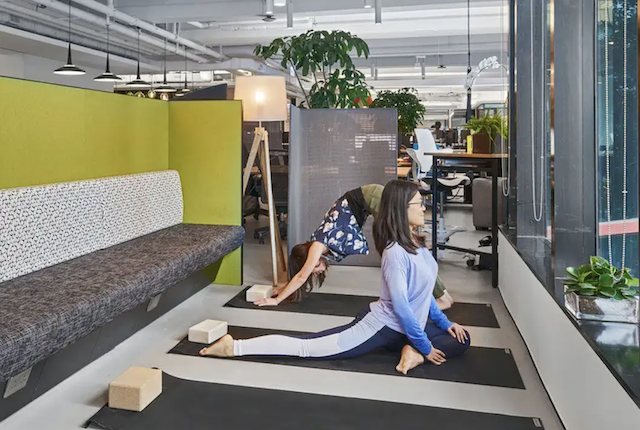
We want the office to function like a self-sustaining community with premium services. We want to see companies designing spaces that offer a "life" alongside work. If we’ve learned anything since 2020, it’s this: to earn the commute, the office has to offer an experience that employees just can't get at home. Not only does a premium office experience encourage teams to come in, but it also delivers real value to HR, where wellness initiatives directly drive higher retention.
Real-world examples we love:
- Pernod Ricard’s "The Island" (Paris): They built a functioning "Main Street" (La Rue). This central corridor isn't a hallway; it is a service hub. It features a concierge desk that handles personal errands, a travel agency, a gym, and a "click & collect" area for personal packages. They managed to turn the daily commute into a convenience, saving employees time on life admin.
- Adidas’ "World of Sports" (Germany): This campus proves that "dining" is a critical part of workplace hospitality. Their "Halftime" building operates as a multi-vendor food hall with healthy, restaurant-quality options designed to fuel their teams. Beyond food, the campus includes a track, a climbing wall, and on-site physiotherapists. It treats the employee as a "corporate athlete," providing the physical infrastructure for health and wellness that a home office simply cannot match.
4. We Want the Office to Be a Sanctuary for Focus
One thing the home office often lacks is guaranteed silence (especially if you have a dog or kids). Yet, in many open-plan offices we visited last year, silence was impossible to find because of the "shoulder-tap" culture.
What we want to see in 2026: We want the office to respect the need for deep work. We hope to see more differentiated zones where the environment adapts based on the work style.
We want to see digital signage used as a "guardian" for these spaces. In a designated quiet zone, the displays should reflect that vibe, perhaps dimming their brightness or showing "Quiet Zone" prompts to remind passersby to lower their voices. The office should offer a level of focus that is harder to achieve at home.
We wrote an article about what a great workplace looks like, which dives more deeply into what the office should look like based on employees’ needs. Read it here.
The Bottom Line
In 2026, we don't want employees to just "go to work." We want them to subscribe to an experience that is demonstrably better than working from the couch. That is the office we are excited to help build with our workplace management solutions.