
Premium coworking success requires an integrated tech stack that removes friction for corporate members and automates manual admin, allowing managers to focus on community rather than paperwork.
If you're managing a coworking space targeting corporate teams and professionals who pay premium rates, outdated technology is costing you deals. The spaces winning these clients are offering better systems.
In this article, we will cover what you need to have in your workspace management stack to compete on the market and to delight your corporate customers.
Key Takeaways
- Integrated Tech is the Standard: Clients now demand more than just a desk; they want a unified stack where room booking, hot desking, and wayfinding sync perfectly with their own corporate calendars to eliminate scheduling friction.
- Security for Enterprise Clients: Large corporate teams (like those in finance and AI) require professional-grade security. Moving from physical keys to mobile access and digital visitor logs is essential to win and keep these high-paying contracts.
- Automation Reclaims Your Time: Coworking managers spend over half their day on manual tasks. A central management system that automates billing and member access turns tech from an expensive "cost centre" into a "revenue driver.
Understanding Your Members
To design a workplace management tech stack that satisfies clients, you must first understand the demographic shifts and psychological drivers of the 2025 member. The average member is 36 years old, with Millennials (61%) and a rapidly growing Gen Z cohort dominating the user base. This is a "tech-forward" audience that views digital fluency as a core brand promise of their workspace.
Approximately 55% of global corporations now utilise flexible office solutions. Large enterprises, particularly in the Banking, Financial Services, and Insurance (BFSI) sector, account for the highest occupancy rates at 32.4%, followed closely by professional services and the rapidly expanding IT/AI sector.
Corporations need "enclosed offices" that provide the same privacy, security, and branding opportunities as a traditional headquarters, but with the flexibility of a coworking contract. This shift has profound implications for the tech stack, as enterprise clients bring with them rigorous requirements for cybersecurity and data isolation.
What Drives Members Away
Noise and distractions remain the number one complaint in shared environments. Research confirms that workers can take up to 23 minutes to fully refocus after a single distraction.
Inconsistent service, outdated equipment, and security vulnerabilities are primary drivers of professional client churn. Implementing the right tech stack directly addresses these frustrations by providing robust systems, secure access protocols, and a seamless workspace experience.
Meeting Room Displays
Room booking systems manage meeting room reservations, prevent double bookings, and maximise space utilisation across your coworking space.
Door Tablet provides touch screen displays outside each meeting room detailing current and future meetings and allowing bookings at the door. Your members glance at the screen and immediately know if they can grab the space or need to keep walking.
The system seamlessly connects with Microsoft 365, Microsoft Exchange, Google Workspace, HCL Domino, and more. When someone books a meeting through their corporate calendar, it instantly appears on the tablet display.
Check out our meeting room tablets.
Hot Desking
Hot desking systems track desk availability in real-time, manage flexible seating assignments, and eliminate conflicts over workspace.
Hot desking is wonderful in theory and absolute chaos in practice. You've got freelancers who show up at 7 AM expecting their favourite spot, remote workers from corporate accounts who bought day passes, and regular members who just want consistency.
Door Tablet BOOKER is a web-based platform that allows desks to be booked using intuitive interfaces.
Door Tablet BOOKER can display the details of every desk booking on desk devices, or work as a software only solution. Members can see a map of available desks before they even walk in via the web platform.
Door Tablet BOOKER integrates with the same calendar systems as the room booking system, and can use single sign-on for ease of access..
“Tech is often the third most expensive thing in the coworking business: the first being real estate, the second being people. What many are realizing is that if you spend correctly on tech, you can get better returns on real estate and have happier people. Deployed correctly, tech goes from an expensive cost-centre to a streamlined revenue-driver.”
- Hector Kolonas, co-founder of Synacroo and author of This Week in Coworking
Wayfinding Displays
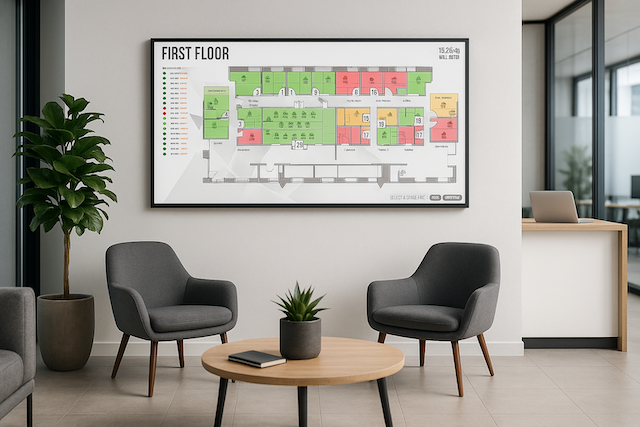
Wayfinding systems help members and visitors navigate your space, locate booked rooms or desks, and find amenities without getting lost.
When someone books Conference Room 3C for the first time, they have no idea where that is. When a corporate team arrives for their weekly standup, half of them end up on the wrong floor. "I couldn't find the room I booked" is not the experience you want people to associate with your space.
Door Tablet's wayfinding displays provide an overview and clarity through interactive floor plan displays. These typically sit in common areas like lobbies, elevator banks, or the entrance to each floor.
Members search for a specific room or desk, see exactly where it is on the floor plan, and see the route for how to navigate there. The floor plan shows real-time availability status.
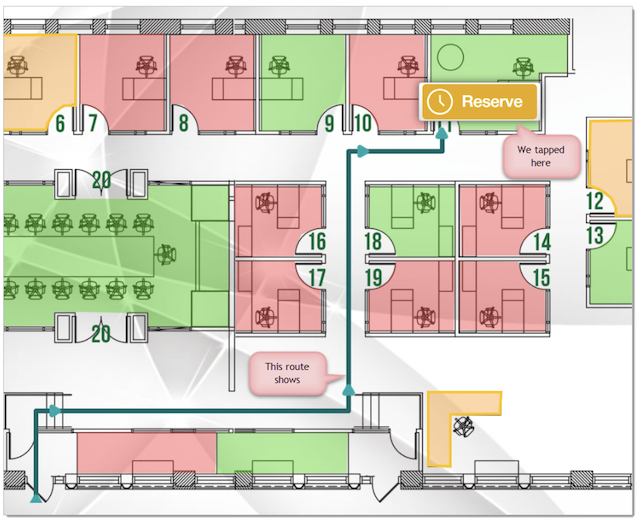
The wayfinding system integrates directly with your booking platform. When someone reserves a meeting room through their calendar, it's already marked on the wayfinding display.
Access Control Systems
You need to know who's in your building at all times. You need to grant different levels of access based on membership tiers, with some people getting 24/7 entry and others only during business hours. And you need to do all of this without making people fumble with physical keys or wait at reception every time they walk through the door.
Mobile credentials or RFID systems manage building and room access through your membership database. These systems control who enters which areas, enforce membership tier permissions, and maintain security logs for compliance.
Members enter without fumbling for keys, get automatic access to booked rooms during reservations, and experience seamless permission changes when memberships update. Granular controls let you set which doors, which days, and which hours, all from one dashboard with real-time activity tracking.
Visitor Management System
Corporate clients need to feel confident bringing their teams and clients to your space. That means professional check-in experiences, not someone hunting for a pen to sign a paper logbook.
Digital check-in systems register guests, print badges, notify hosts, and track building occupancy for safety compliance. These systems manage guest arrivals professionally while maintaining security records and meeting building safety regulations.
Visitors check in without waiting at reception, hosts receive instant arrival notifications, and you maintain complete records for emergencies. Modern systems eliminate paper logbooks as guests pre-register, check in at kiosks, and receive badges automatically while the system grants temporary building access.
Member Engagement Platform
Here's the thing about coworking. People aren't just renting a desk. According to surveys from multiple industry sources, the top reasons people join coworking spaces are community, networking, and schedule flexibility, with 80% of members saying they are happy to have someone to interact with. If you're not facilitating those connections, you're just renting desks.
“There is still a need for human connection [...] You’re going to lose it if you don’t remember it’s what makes your space thrive.”
- Jaime Munoz
A branded mobile app serves as the central hub for bookings, community features, events, member directories, and exclusive perks. These platforms facilitate member connections and direct communication, creating the community experience that differentiates coworking from traditional office rentals.
Members manage all bookings from one app, discover and connect with others in their industry, RSVP to events, and receive push notifications that actually get read. The platform integrates with your booking system, access control, and CMS for a unified experience where everything works from one interface.
Coworking Management Software
This is the system that connects everything else. Your CMS manages memberships, processes payments, generates invoices, tracks occupancy across all your desks and offices, and produces financial reports.
Coworking space owners and operators spend 53% of their time performing manual tasks in technology tools each day. That's more than half your working hours on administrative busywork instead of growing your business or supporting your community.
The central operating system manages memberships, billing, payments, occupancy tracking, and financial reporting while integrating with all your other tools. It connects everything else, automates administrative tasks, and provides real-time data on your entire operation from one dashboard.
When someone signs up online, the right CMS automatically creates their profile, processes payment, sends welcome emails, assigns access permissions, and adds them to your member app. When invoices are due, reminders go out automatically. When you need occupancy rates across all locations, you pull them up instantly.
The Bottom Line
These corporate clients have high expectations. They're used to seamless digital experiences in every other part of their lives, and they expect the same in their workspace.
Your workspace tech stack, with Door Tablet handling room booking, hot desking, and wayfinding as a unified solution, complemented by access control for security, visitor management for professionalism, member engagement for community, and a comprehensive CMS tying it all together, has become the foundation that lets you scale without drowning in manual work.
The best coworking spaces win by making everything just work, so you can focus on what actually matters. The people walking through your door.