Key Takeaways
The Collaboration Paradox: Moving to an open layout can trigger a 70% drop in face-to-face interaction as employees retreat into digital silos to find privacy.
The Productivity Tax: Constant interruptions in open environments lead to a loss of up to seven hours of productive work per week for every employee.
A Shift in Strategy: Modern planning is moving away from the "all-or-nothing" battle, with a 25% year-over-year reduction in global "me" space to better balance private focus with community areas.
What is the difference between an open office and a closed office?
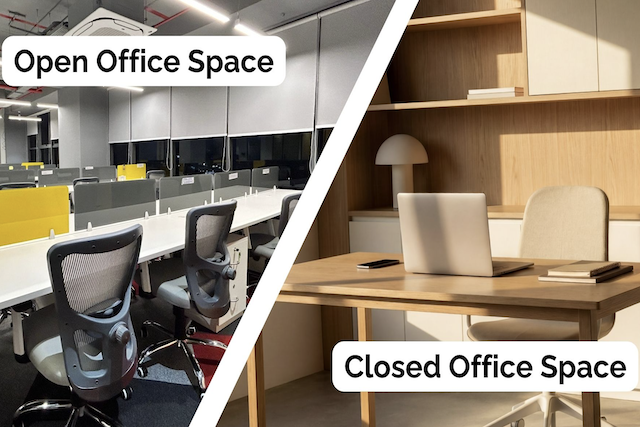
An open office is a workspace characterised by a lack of interior walls, where desks are placed in large, shared areas to encourage visibility. A closed office uses physical partitions and doors to create private or semi-private environments for individuals and teams.
Architecturally, both environments can support health through natural lighting and modern ventilation systems. The real differentiator is the office UX, as open layouts prioritise a communicative atmosphere, whereas closed offices are built for precision and minimal sensory distraction. While open plans dominate, housing 49% of UK employees, they often lack the acoustic boundaries required for sustained cognitive performance.
Are closed offices better than open offices?
The effectiveness of an office layout depends entirely on the specific work activities and the company's organisational goals. Closed offices are superior for strategic discussion and high privacy, while open offices excel at supporting fast, spontaneous communication.
Choosing the better option requires looking at the data, which shows that face-to-face interactions can actually drop by 70% in open layouts as employees retreat into digital silos to find a sense of privacy. Conversely, closed offices can lead to social dissatisfaction due to physical barriers that limit organic team bonding.
Compare productivity in private offices vs open office space
Private offices typically support higher productivity for individual tasks because they eliminate the 86 minutes of daily work lost to distractions in open environments. Open offices offer efficiency for quick team coordination but often impose a productivity tax, with only 41% of workers feeling they can concentrate effectively.
The cognitive load is significantly higher in open spaces due to an increase in exposure to stimuli from the absence of physical boundaries. When employees lose focus due to audio or visual interruptions, it takes time to recover their momentum, leading to a loss of up to seven hours of productivity per week.
Are open-plan offices better?
Open-plan offices are better for reducing real estate costs and providing a flexible, dynamic atmosphere for teams that require constant interaction. They are not better for employee well-being, as workers in these environments take 62% more sick days due to elevated stress levels and easier transmission of illness.
For many managers, the financial appeal of fitting more desks into less space is offset by the fact that a third of their staff may feel the need to leave the office entirely to get meaningful work done. The goal is to move toward Activity-Based Working (ABW), where 53% of companies now provide a mix of settings, including quiet zones and breakout rooms, rather than a single, open room.
What are the main advantages of closed offices over open office spaces?
The primary advantages of closed offices are superior acoustic control, the protection of confidentiality, and the ability for employees to regulate their own environment. These spaces provide the quiet needed for deep work and the professional atmosphere required for hosting clients.
Enclosed spaces also mitigate environmental dissatisfaction by providing the psychological safety needed for sensitive tasks.
What are the disadvantages of a closed office or an open plan office?
The main disadvantage of a closed office is the limitation of spontaneous social interaction, which can make an organisation feel fragmented or siloed. Open offices suffer from a lack of visual and auditory privacy, leading to the highest levels of employee dissatisfaction regarding concentration levels.
In open plans, the lack of boundaries often forces employees to use headphones as digital walls, which ironically decreases the very collaboration the layout was meant to foster. A study in Environment and Behaviour followed 21 employees who were relocated from traditional offices to open offices. Four weeks after the move, employees were not happy with their environment, stress levels, coworker relations and perceived job performance. Six months after the move, they were still unhappy, and team relations broke down further.
In closed offices, the lack of flexibility can make the environment feel static and less adaptive to quick, high-energy group discussions that demand immediate coordination.
Are closed offices outdated?
Closed offices are not outdated but are being reimagined as focus hubs within a hybrid, flexible workspace concept. Modern design is shifting away from the all-or-nothing approach toward a mixed layout that combines open lounges with enclosed meeting pods and quiet rooms.
How Modern Planning Rebalances "Me" and "We" Space
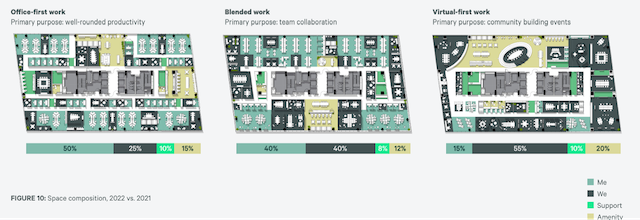
Research by CBRE indicates that workplaces require new planning concepts informed by employee needs and actual space utilisation patterns. These concepts rebalance the allocation of private "me" space and community "we" space to improve flexibility and equitable collaboration for employees working both remotely and face-to-face. When comparing existing portfolios with these new models, there is often a noted deficit of collaboration space and an excess of support space.
A 25% year-over-year reduction in global "me" space indicates that more organisations are making material progress in rebalancing their portfolios to better support hybrid work. This shift represents a move away from the binary choice of a purely open or purely closed office. Instead, it suggests a strategic distribution where private offices are not eliminated but are right-sized to ensure they serve as functional "me" spaces, while "we" spaces are expanded to facilitate the teamwork that open plans often fail to support.
Bottom Line: Designing for Choice, Not Compromise
The open-plan office was a bold experiment, but the data confirms it often misses the mark on productivity and employee satisfaction. Modern office design needs to move away from the obsession with fitting the most desks into the smallest space. Instead, the real goal is to align your physical environment with how people actually work by offering a deliberate choice between collaborative zones and quiet rooms.
A mixed layout featuring open lounges, enclosed pods, and quiet spaces allows people to move between different types of work without losing their focus. When an office is designed with a clear purpose, it becomes a genuine asset where deep work is protected and coming in feels worthwhile.
Flexible booking systems like Door Tablet help organisations build a responsive workplace that actually makes sense. Teams need spaces where they can make their own choices based on the task at hand, ensuring they never feel like they are making a compromise between working together and getting things done.