
Activity-based working relies on smart workspace management technology to prevent office chaos and capture accurate space utilisation analytics. Giving your team the freedom to choose different zones for specific tasks demands a system that maps out real-time availability across the entire floor plan. Your hybrid workplace strategy falls apart if people cannot easily locate and reserve the exact spaces they need.
Key Takeaways
Task-specific zones increase efficiency: Replacing assigned seating with dedicated work areas reduces the total office space needed per employee.
Disconnected tech creates friction: Flexible offices struggle without unified booking systems, causing wasted time and unused room reservations.
Data drives floor plans: Linking booking tablets and sensors provides real-time occupancy metrics to help you adjust layouts accurately.
What is Activity-Based Working (ABW)?
This model moves away from the traditional concept of assigning one desk to one person. It provides a variety of purpose-built spaces tailored to specific tasks instead. An employee might start their morning in a quiet focus pod, move to an open collaborative zone for a team brainstorm, and take an afternoon client call in a soundproof phone booth.
The Proven Benefits of ABW
ABW environments, to a greater extent than traditional offices, satisfy employees' needs and preferences, as well as their autonomy, thereby stimulating creativity by allowing individuals to use various work environments and manage their time in ways that enhance their creative process (Heerwagen & Kinzie, 2007). It can also contribute to more efficient resource utilisation (Jung et al., 2020). Research confirms that by implementing shared collaborative areas and flexible workstations, organisations can reduce office space and the overall amount of square footage needed per employee (Maina et al., 2019).
Employees are 2.5× more likely to say their workplace supports both individual and team productivity when they have access to diverse, task-based spaces, especially ones built for collaboration.
- Gensler’s 2023 Global Workplace Survey
Why ABW Fails Without Workspace Management Tech
Transitioning to an activity-based working office means shifting from assigned desks to a flexible, task-driven environment. The core hurdle is overcoming resistance to change while optimising space and technology. Moving to this model presents several specific obstacles:
- The "My Desk" Mentality: Employees often feel a loss of ownership or territoriality when they no longer have an assigned workspace.
- Space Mismanagement: Poor zoning can lead to a lack of quiet zones or overcrowding in collaborative areas.
- Distractions: Activity zones require acoustic shielding. Noise levels can disrupt focused work.
- Tech Disconnects: Equipping different zones with mismatched hardware and booking tools creates immediate frustration when those separate systems cannot communicate with one another.
Relying on a manual or poorly integrated booking system for these spaces creates immediate friction. Employees waste valuable time wandering the floor looking for the right place to work, whether they need a hot desk, a focus pod, an open collaborative space, or a quiet area.
Abandoned bookings present another massive roadblock. This happens when a space is reserved on the calendar, but no one actually shows up. These unused reservations lock others out of usable spaces and frustrate teams who just need a place to sit down and work. With effective workspace management solutions, you can eliminate these challenges for good.
The Essential Tech Stack for Activity-Based Working
Eliminating Friction with Conference Room Displays
Placing a conference room display in key areas solves the visibility problem instantly. Employees can see real-time availability as they walk past. These tablets are highly versatile and allow your team to book different spaces across the office, regardless if it is an enclosed meeting room, a hot desk, or an open collaboration area. If a space is free, staff can book it directly on the screen. If it is occupied, they can use the interface to find and reserve alternative areas nearby.
Tracking True Usage with Meeting Room Sensors
Meeting room sensors track actual occupancy data within your spaces. When someone books an area but fails to show up, the hardware detects zero motion. The system then automatically releases the reservation back to the calendar. This prevents unused bookings from tying up valuable real estate and ensures your scheduling system always reflects reality.
Wayfinding Displays
Wayfinding displays show exactly what is happening across the entire office floorplan. If an employee books a room or a desk, they can look at the main screen and get clear directions to their reserved space. This prevents the daily confusion of navigating a flexible office layout.
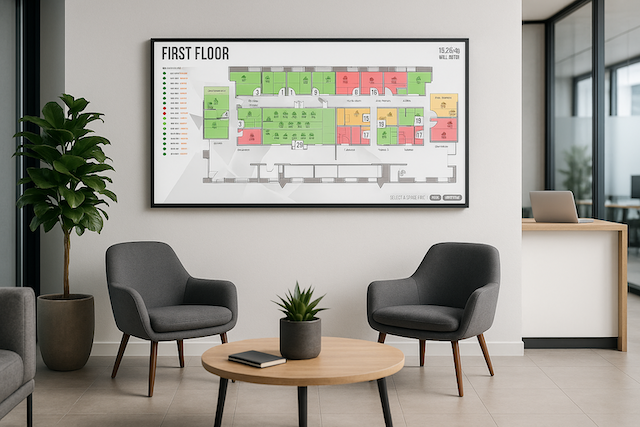
How Sensors and Displays Work Together to Optimise Space
These tools work best as a connected ecosystem. Sensors provide the raw occupancy data, the software processes this information, and the displays communicate it to employees instantly.
Facilities managers can then review the resulting data to understand which zones are popular and which remain underutilised. You can adjust your floor plan based on hard facts rather than assumptions.
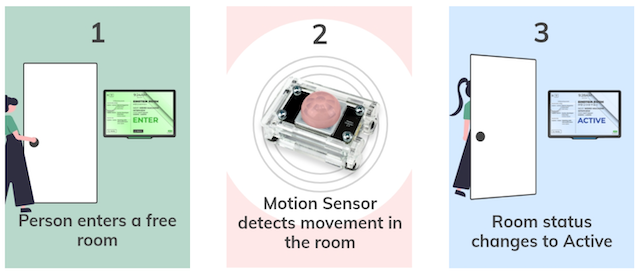
Build a Smarter Workspace Today
Managing an activity-based working environment successfully requires the right hardware and software. Deploying meeting room sensors with conference room displays gives your team the tools they need to navigate the office without frustration. You also gain the occupancy data required to continually refine your spaces.
Ready to improve your office experience?
Book a demo with Door Tablet today!
FAQs
How do meeting room sensors improve activity-based working?
They track actual human presence instead of relying on calendar data. If a scheduled meeting does not happen, the sensor detects the space and frees it up for other employees to use.
Do I need a conference room display for every meeting space?
It depends on your space; placing a screen near enclosed meeting areas and open zones provides immediate clarity. It prevents interruptions, shows schedule availability, and allows staff to secure any space instantly.
What is the difference between hot desking and activity-based working?
Hot desking simply means employees do not have assigned seats and grab any available desk. Activity-based working is a broader strategy providing distinct, specialised areas designed for specific task types.